The One-Origin Story Behind a Regional Dish
A regional dish rarely has one uncontested birthplace. Trace shared ingredients, recipe changes and culinary routes to understand what its origin story leaves out.
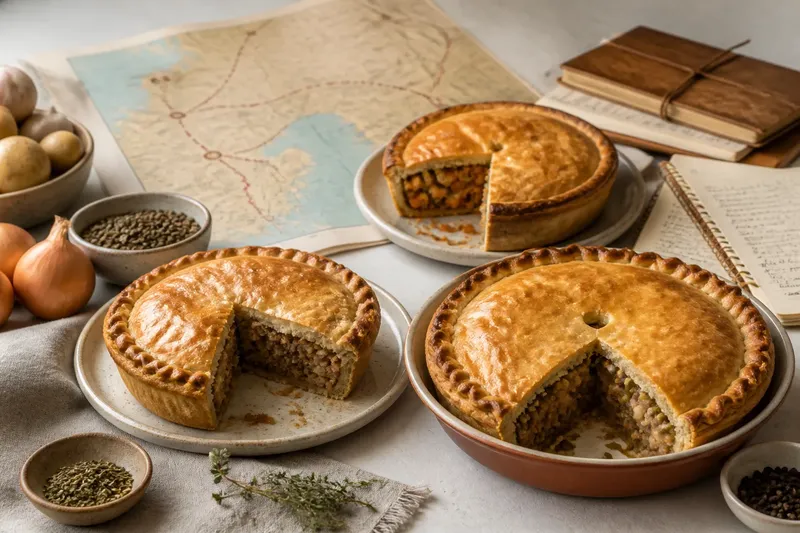
A regional dish rarely has one uncontested birthplace. To understand a dish’s origin story, look beyond the place named on a menu and follow its ingredients, changing recipes and routes between neighbouring communities.
That does not make local claims meaningless. A community may have shaped a dish into a distinctive form, given it a name, or made it part of a shared calendar. The useful question is often not “Who invented it?” but “How did this version become associated with this place?”
Regional dishes often have more than one beginning
Food origins can refer to several different things: the earliest known combination of ingredients, a recognisable recipe, a name, a cooking method, or the point at which a dish became a local emblem. Those beginnings need not coincide.
Consider a filled pastry shared across a border. One town might be closely associated with its shape, another with a particular filling, and a third with the name that later appears in cookbooks. Each association can be real without proving that the whole dish began in a single kitchen.
Oral accounts, household habits and written recipes also preserve different kinds of evidence. A recipe may record a dish only after it has circulated for years; a family account may describe a local practice that was never written down. Neither source, on its own, settles every part of the story.
Ingredients and techniques travel along ordinary routes
Shared dishes often emerge where people exchange goods and skills. Market roads, ports, seasonal work, migration, marriage and military service can carry ingredients and cooking habits across regions. A cook may adapt what arrives to local crops, fuel, equipment or taste.
That adaptation matters. A method such as slow cooking in a covered pot may be widespread, while a local combination of meat, pulses, herbs and souring ingredients becomes recognisable as a particular regional dish. Similarity does not automatically mean copying, and a shared ingredient does not establish a single point of origin.
Names travel too, sometimes changing as they pass between languages or acquire a new meaning. A dish may be known by one name in a market town and another in nearby villages, even when the preparations overlap. Naming can strengthen a regional claim, but it is only one strand of the history.
Recipe changes reveal how a dish becomes local
Recipes are not fixed records of an original form. Household cooks adjust them to what is available, affordable or familiar. A dish can become locally distinctive through a change in seasoning, texture, cooking vessel or serving custom, even if its broader structure is shared with neighbouring places.
When comparing versions, focus on features that can be observed rather than on a single claim of authenticity:
- Main ingredients: Which ingredients recur, and which appear only in some versions?
- Preparation: Are foods baked, stewed, fermented, grilled or assembled without cooking?
- Seasoning: Do local herbs, spices, preserved foods or souring agents shape the flavour?
- Occasion: Is the dish associated with a market day, harvest, religious calendar or family gathering?
- Name and form: Do local names describe a shape, ingredient, technique or place?
These details help distinguish a family variation from a wider regional pattern. They also make room for change: a version can be locally meaningful without being the only legitimate one.
How can you trace a dish without choosing a winner?
What counts as the dish’s origin?
Decide which origin you mean: the first known recipe, the development of its familiar form, its name, or its adoption as a regional symbol. A clear question prevents different kinds of evidence from being treated as though they answer the same thing.
How do neighbouring versions compare?
Compare ingredient lists and cooking methods from nearby communities, then note both shared features and local differences. Recipes in cookbooks, menus and household collections can help, but each may describe a particular period or social setting rather than an entire region.
Why do origin stories become local claims?
A named dish can express belonging, support a local food business or give a festival a recognisable focus. Those uses explain why communities may defend a particular story; they do not, by themselves, confirm or disprove its historical details.
Can a dish belong to several places?
Yes. A dish may be associated with one place for a distinctive ingredient, another for a recognisable preparation, and a wider area for the shared food tradition. Multiple connections can be described precisely without pretending every claim is identical.
A short tracing routine makes the story clearer
Use a week to investigate one dish without turning the exercise into a search for a single winner. Keep a small note of what each source actually says, and separate observation from interpretation.
- On the first day, define the dish. Write down its common name and the features you consider essential, such as its filling, texture or cooking method. If local versions differ, record that before comparing claims.
- On the second day, gather nearby recipes. Look at cookbooks, community recipe collections, restaurant menus or food-heritage materials from the places associated with the dish. Note the source and the wording it uses rather than copying a claim without context.
- On the third day, map shared ingredients. List which ingredients occur across versions and which seem tied to particular local preparations. Treat absence from a recipe as a clue, not proof that an ingredient was never used.
- On the fourth day, compare techniques. Mark differences in cooking vessel, heat, preparation and serving. A technique may travel more widely than the dish’s name, so keep those observations separate.
- On the fifth day, look for routes. Consider nearby markets, ports, seasonal work and migration as possible channels for exchange. These are useful questions to investigate, not automatic explanations for a particular recipe.
- On the sixth day, compare local accounts. Notice whether people describe the dish as a family food, a festival meal, a trade speciality or a regional emblem. Preserve disagreements instead of smoothing them into one story.
- On the seventh day, write a qualified account. State what is shared, what varies, and what each place is especially associated with. If the evidence does not establish a first birthplace, say so plainly.
Imagine you are tracing a savoury pie found in three neighbouring towns. You note that all three use a similar crust, while one version contains local greens and another is served chiefly at a seasonal gathering; the result is a clearer account of shared technique and distinct local meanings, not a declaration that one town owns the pie.
Describe connection without flattening local identity
Careful language can acknowledge both overlap and attachment. “Associated with” is useful when a dish is strongly identified with a place but its earlier history remains uncertain. “A local version of” can describe a recipe that shares a broader form, while “documented in” says where a recipe appears without claiming that it began there.
Be specific about what a community contributes. A place may have shaped a familiar seasoning, maintained a cooking custom, or made a dish central to a gathering. Naming that contribution gives local identity its due without converting cultural connection into exclusive ownership.
For a reader trying to understand a regional dish, the one-origin story is only a starting point. Trace what travelled, notice what changed, and name the places that made those changes matter. That account is often more useful than an unsupported claim of a single birthplace.