The Layers Inside a Place Name
Learn how to read the layers inside a place name by checking its sounds, spellings and records without treating one label as a complete local history.
A place name can carry several histories at once: an older word may survive inside a newer pronunciation, while a later map fixes one spelling for official use. To read the layers inside a place name, begin with the forms people use now, then compare them carefully with local records rather than treating the name as a miniature history book.
Start with the name as people say it
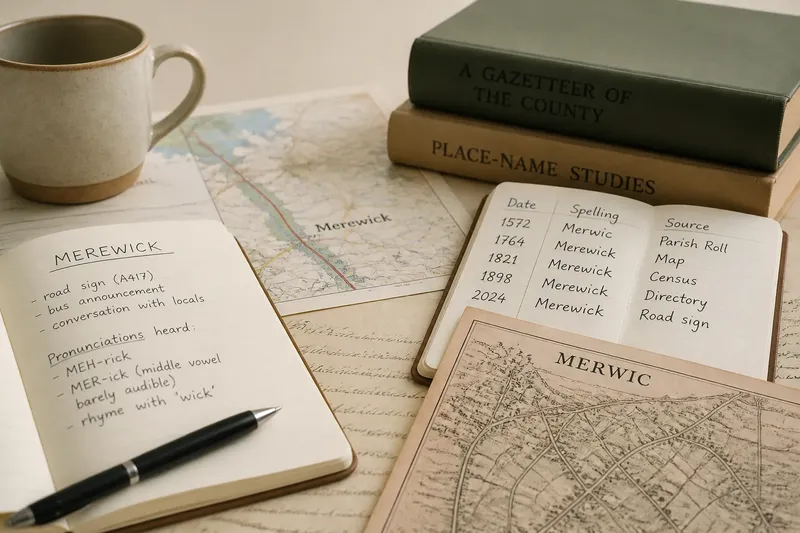
Write down the name you want to investigate and note where you encountered it: on a road sign, a map, a bus announcement or in conversation. These sources may differ, and that difference is useful evidence. A sign records an official choice; a speaker’s pronunciation may preserve a local habit that the sign does not show.
Ask more than one local speaker how they say the name, if that feels appropriate. Listen for stress, shortened syllables and sounds that might be missed by ordinary spelling. Do not assume that an unfamiliar pronunciation is careless or that the written form must be the truest one.
Record what you hear in plain language, such as “the middle vowel is barely audible”, rather than forcing it into a technical phonetic notation. Keep your notes separate from guesses about what the name means.
Compare spellings across local records
Next, look for the name in sources made for different purposes. Useful places to start include old and current maps, parish or council records, street directories, local newspapers and the catalogues of nearby archives. A library catalogue may also point to a local place-name survey or a collection of historical documents.
Copy each spelling exactly, including spaces, hyphens and unusual letters, and note the source beside it. A list in date order can reveal changes in spelling, but it cannot by itself explain why they happened. A clerk may have written down a pronunciation, a printer may have simplified a letter, or an authority may have chosen a standard form for administration.
Check whether each source refers to the same place. A name may once have applied to a farm, stream or wider district before being attached to a settlement, or nearby places may share similar names. A map’s labels and boundaries can help distinguish these possibilities.
Separate sound changes from spelling decisions
Pronunciation and spelling change at different speeds. People may continue to say a name one way after an official spelling has shifted; conversely, a familiar written form can persist even as everyday speech changes. Treat these as related but separate strands, not as proof that one form is correct and another is mistaken.
Look for changes that could reflect sounds being reduced, added or adapted to another language. A borrowed name may be reshaped to fit the sounds and patterns familiar to new speakers. But a resemblance between two words is only a clue: it does not establish that one came from the other.
Say you are tracing a fictional village called “Merewick”. An older map spells it “Merwic”, while several residents pronounce the ending like “wick”. That gives you a documented spelling difference and a living pronunciation to investigate; it does not, on its own, tell you who first named the village or what its earliest form meant.
Use sources to test possible language layers
Once you have a set of forms, ask what kinds of evidence could support a proposed language history. A local word list, place-name study or specialist reference may explain a root or a sound pattern. Compare its reasoning with the forms you have collected, and check whether the source distinguishes a documented form from a proposed interpretation.
A place name can contain an older element that later speakers no longer recognise, or combine elements from different periods. It can also be reshaped by administrative spelling without changing its underlying spoken history. These possibilities make language layers worth investigating, but they do not make every short or unfamiliar name ancient.
Keep competing explanations in view when the evidence is incomplete. A specialist’s interpretation may be more persuasive than a casual resemblance, yet uncertainty can remain, especially when early records are scarce or inconsistent.
Read administrative forms as part of the story
Maps, postal systems, local government and transport networks need names that can be identified consistently. Their preferred form may therefore reflect a practical decision, such as choosing one spelling from several variants or distinguishing two places with similar names.
Look for signs of that process in council minutes, boundary descriptions, map revisions or official naming records where available. A standardised spelling tells you how an institution chose to label a place at a particular point; it does not necessarily show how residents spoke, or settle the name’s deeper origin.
When the right interpretation depends on a specialist source, an official record or a locally held document, follow that source’s wording and explain what it can establish. Avoid turning an administrative choice into a claim about the identity or language of every person who lives there.
Which questions help make sense of a place name?
Does the oldest spelling reveal the original meaning?
Not necessarily: the earliest form you can locate is only the earliest one in the records you have checked. It may already reflect centuries of speech change or a scribe’s spelling habits.
Why do local speakers pronounce a name differently from a map?
A map records a chosen written form, while speech follows local habits that can persist or change independently. The difference may also reflect how a written form is interpreted by people unfamiliar with the local pronunciation.
Can a place name identify the language of its first settlers?
A name may offer evidence about language contact, but it rarely identifies a whole population by itself. Settlement, borrowing and renaming can leave overlapping traces that need to be considered alongside other records.
What should I do when sources disagree?
Record each version with its source and date, then compare what kind of evidence each one provides. If no explanation accounts for all the forms, say that the origin remains uncertain rather than choosing the neatest story.
Write a careful account of what the name can tell you
When you share your findings, distinguish observation from interpretation. “This map uses the spelling ‘Merwic’” is a direct report; “the name comes from an older word for a boundary” is a claim that needs supporting evidence. A clear account makes that difference visible to readers.
Include the present pronunciation, the documented spellings you found and the sources that support any language or administrative explanation. If records leave a gap, name it plainly. The layers inside a place name can point towards local change without supplying a complete account of who lived there, what they called themselves or how the surrounding community developed.
For a useful final check, ask whether your wording gives a reader a way to distinguish a recorded fact from a plausible interpretation. That small distinction keeps a place name’s history interesting without asking it to carry more than the evidence allows.